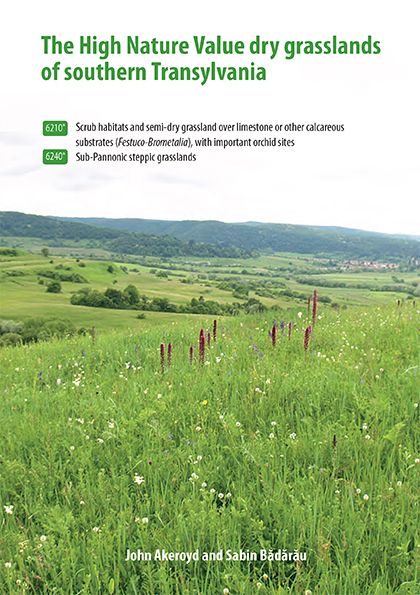
In the SCI there are 2 priority dry grassland habitat types which are threatened by land use changes: 6210* and 6240*:
6210* dry grasslands over limestone or other calcareous substrates (Festuco-Brometalia),with important orchid sites.
Covering about 4% of the Sighișoara-Târnava Mare area.
In the project area, the calcareous substrate is largely marl or lime-rich clay. This type of grassland, dominated by Upright Brome (Bromopsis erecta) and fescues (Festuca species), is widespread on south and west facing slopes, both steep and gentle, with few or no trees. On deeper, slightly less dry soils of higher nutrient levels, it grades into another type of dry grassland dominated by Tor-grass (Brachypodium pinnatum). These grasslands are often a rich carpet of wild orchids and other wild flowers, including Red Viper’s-bugloss (Echium maculatum), Jurinea (Jurinea mollis) and Three-toothed Orchid (Orchis tridentata).
Characteristic butterfly species include the Dryad (Minois dryas), Hermit (Chazara briseis), Green-underside Blue (Glaucopsyche alexis) and Chestnut Heath (Coenonympha glycerion).
6240* Sub-Pannonic steppic grasslands
Covering about 2% of the Sighișoara-Târnava Mare area.
These steppic-type grasslands occur on the steepest sunny slopes and are dominated by various grasses, especially feather-grasses (Stipa species) as well as Chrysopogon gryllus, Dichanthium ischaemum and the small sedge Carex humilis. In this habitat we find several rare plant species including the showy Steppe Sea-kale (Crambe tataria), Burning Bush (Dictamnus albus) and Nodding Sage (Salvia nutans), and the dwarf flowering shrub Steppe Almond (Prunus tenella).
Butterflies found here include Large Blue (Maculinea arion), Chalkhill Blue (Polyommatus coridon), Yellow Banded Skipper (Pyrgus sidae), Eastern Baton Blue (Pseudophilotes schiffermuelleri) and Red-band Fritillary (Melitaea didyma).
About 5,000 ha of these rare and protected habitats exist in the SCI. Of these, about 1.000 ha are poorly managed: overgrazing in easily accessible sites, abandonment of less accessible grassland (causing spreading of thorny scrub). This is the result of neglect and collapse of traditional rural economy.
For further information on the plant and butterfly species linked to these habitats, download the booklets below.